

What is IT Staff Augmentation?
IT staff augmentation is hiring external engineers to work inside your own team, under your management, for as long as you need them. The provider recruits, vets, employs and replaces the engineers; you decide what they build and how. You get the skills without a hiring cycle and keep control of the work — which is the difference from outsourcing, where you hand over a scope and the vendor manages delivery.
It is the right model when you already have a product, a technical lead and a working process, and the bottleneck is capacity or a specific skill: a senior backend engineer, a DevOps engineer, an AI engineer. If that is your situation, our IT staff augmentation services page shows how we place senior engineers from Portugal into existing teams. This guide covers what it is, what it costs in 2026, how it compares with outsourcing, managed services and dedicated teams, and when it is the wrong choice.
IT Staff Augmentation vs Outsourcing, Managed Services and Dedicated Teams
Staff augmentation is a form of outsourcing, but a specific one: you outsource the hiring, not the management. The engineers work in your repositories, attend your standups and follow your priorities. In project outsourcing and managed services, the vendor owns the delivery and you manage the contract, not the people.
| Staff augmentation | Dedicated team | Project outsourcing | Managed services | |
|---|---|---|---|---|
| Who manages the work | You | Shared: you set priorities, the vendor runs the team | The vendor | The vendor |
| What you buy | Engineers' time and skills | A stable team for your product | A defined scope or outcome | An ongoing service at an agreed service level |
| Typical billing | Monthly or hourly, per engineer | Monthly, per team member | Fixed price or time & materials | Monthly fee per service |
| Best when | You have a lead and a process; you need capacity or a skill | A long-running product needs a team you can't hire fast enough | The scope is clear and you'd rather review results | The work is operational and repeatable (support, infrastructure) |
| Main risk | Management load stays with you | Ramp-up time and minimum terms | Change-request friction when scope moves | Less control over how the work is done |
If you are weighing the first two, we compare them in depth in staff augmentation vs dedicated teams; for the operational side, see staff augmentation vs managed services.
How Much Does IT Staff Augmentation Cost?
IT staff augmentation is billed per engineer, usually monthly, and the rate depends mostly on seniority and where the engineer is based. Market ranges published by Accelerance in November 2025 put European developers at $31–39 an hour (junior) and $64–76 (senior), Latin America at $33–45 and $60–75, and Asia at $24–31 and $31–41. At a full-time 160 hours a month, that is roughly:
| Engineer | Hourly rate (market range) | ≈ Monthly cost (160 h) |
|---|---|---|
| Senior, Europe (nearshore for EU/UK) | $64–76 | $10,240–$12,160 |
| Senior, Latin America (nearshore for the US) | $60–75 | $9,600–$12,000 |
| Senior, Asia (offshore) | $31–41 | $4,960–$6,560 |
| Junior, Europe | $31–39 | $4,960–$6,240 |
For comparison, the median US software developer salary was $135,980 in May 2025 — about $11,300 a month in salary alone, before benefits, payroll taxes, recruitment and equipment. The provider's rate, by contrast, already includes the engineer's employment costs, recruitment, replacement if someone leaves, and the provider's margin. These are market ranges to calibrate quotes against, not a price list; for a country-by-country breakdown including coordination overhead, see our nearshoring cost comparison for Portugal, Poland, Romania and India.
The rate is not the whole cost. Budget your own team's time for onboarding and code review, and weight time-zone overlap: an engineer who can't join your standup costs more in waiting and rework than the rate difference saves.
What are the Key Staff Augmentation Advantages?
IT staff augmentation offers numerous advantages for businesses seeking to enhance their technological capabilities and project delivery.
Here are some key benefits of this approach:
- Cost-effectiveness: Reduces expenses associated with full-time hiring, including recruitment, training, and benefits
- Access to specialized skills: Provides immediate access to experts with specific skillsets not available in-house
- Access to global talent: Provides access to a diverse pool of skilled professionals worldwide
- Flexibility and scalability: Allows companies to easily adjust team size based on project needs
- Faster time-to-market: Experienced professionals can accelerate project completion and product launches
- Risk mitigation: Shares development risks with the outsourcing partner and reduces long-term commitments
- Improved productivity: Augmented staff can enhance operational efficiency and output quality
- Focus on core competencies: Enables in-house teams to concentrate on strategic tasks while augmented staff handles specialized work
- Knowledge transfer: Facilitates the exchange of skills and expertise between augmented staff and in-house teams
- Reduced administrative burden: Outsourcing companies handle recruitment and paperwork, saving time and effort
- Enhanced project transparency: Provides better control and visibility over project progress and costs
- Meeting fluctuating demand: Enables businesses to adapt to varying workloads throughout the year
Used well, these benefits let companies optimize their IT operations, stay competitive, and successfully deliver complex projects while maintaining flexibility and cost control.
What Might be Advantages and Challenges of Staff Augmentation?
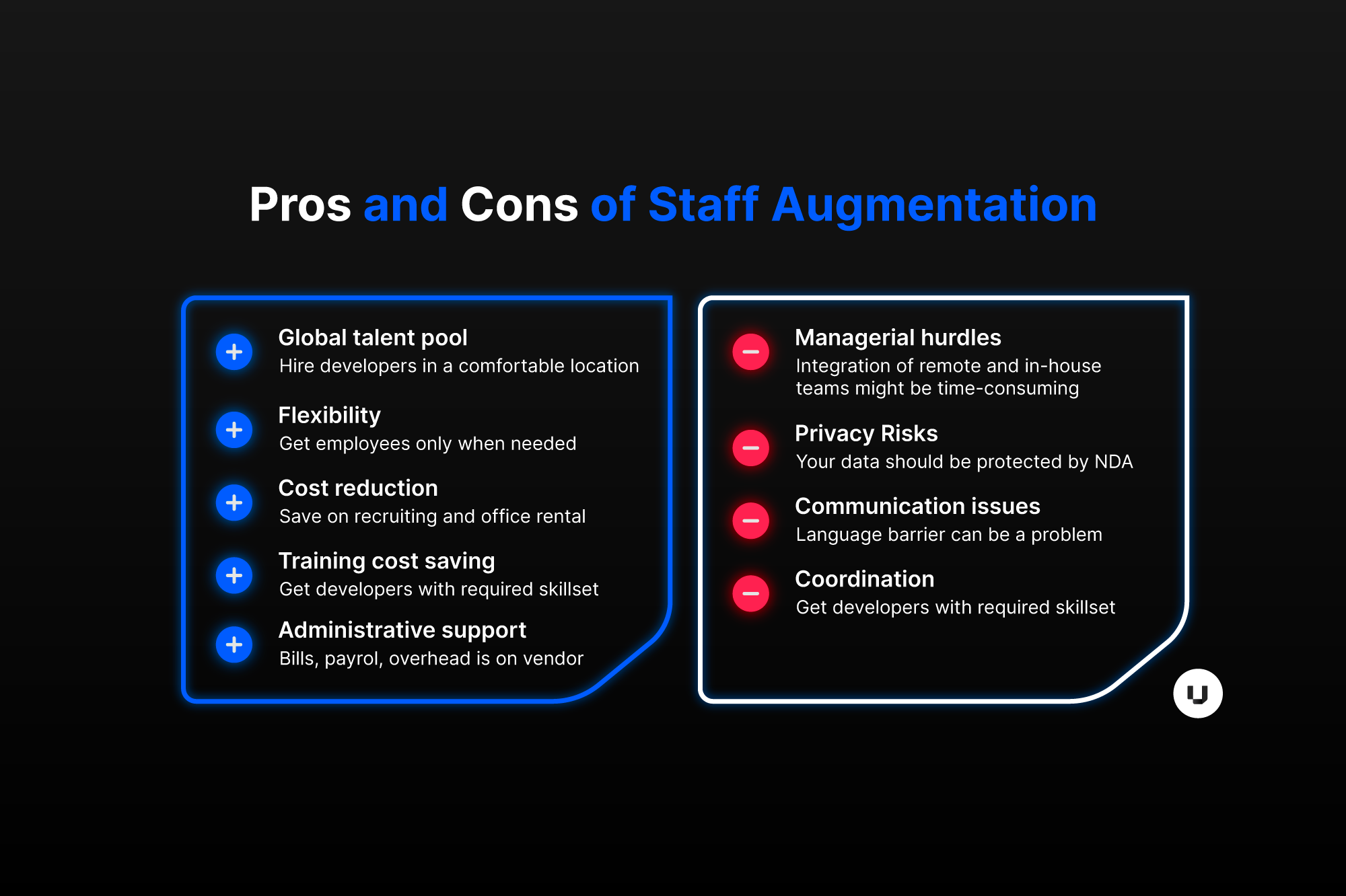
Staff augmentation offers both advantages and challenges for businesses. Here's a concise overview of the key pros and cons:
Pros
- Cost savings: Reduces expenses associated with full-time hiring, training, and benefits
- Access to specialized talent: Provides immediate access to experts with specific skillsets
- Flexibility and scalability: Allows quick adjustment of team size based on project needs
- Faster project completion: Experienced professionals can accelerate time-to-market
- Focus on core competencies: Enables in-house teams to concentrate on strategic tasks
Cons
- Potential communication challenges: Language barriers or remote work can lead to miscommunication
- Lack of long-term institutional knowledge: Temporary staff may not develop deep understanding of company processes
- Integration difficulties: Requires changes to internal processes and tools
- Possible higher long-term costs: Extended use of augmented staff may become more expensive than permanent hires
- Reduced accessibility: Remote work may limit face-to-face interactions and immediate availability
By carefully considering these factors, businesses can make informed decisions about implementing staff augmentation strategies.
Staff Augmentation Categories
Staff augmentation services come in various forms to meet different business needs. Here's an overview of the main types:
| Type | Description |
|---|---|
Short-term | Used for temporary needs or when in-house staff is unavailable |
Long-term | Applied for extended projects or ongoing skill requirements |
Onshore | Hiring talent from the same geographical location as the company |
Offshore | Engaging professionals from different countries, often in different time zones |
Nearshore | Hiring from neighboring or nearby countries, balancing cost and proximity |
Skill-based | Targeting professionals with specific expertise to fill skill gaps |
Project-based | Assembling specialized teams for particular projects |
Contract-to-hire | Offering a trial period before potential permanent employment |
These different types allow companies to flexibly address their staffing needs, whether for short-term projects, specialized skills, or cost-effective solutions across various geographical locations.
Staff Augmentation Service Types
Staff augmentation services come in various forms to meet different business needs. Here's an overview of the main types of staff augmentation services:
| Service Type | Description |
|---|---|
Traditional Staff Providers | Provide temporary laborers for general workforce needs |
Master Vendor Staff Provider | A single vendor manages the entire staffing program |
Specialized/Boutique Agencies | Small companies focusing on highly-specialized talents |
Gig Platforms | Online platforms providing instant access to independent workers |
On-demand Talent Platforms | Online platforms offering access to highly-skilled specialists |
Independent Contractors | Professionals engaged directly by organizations |
These different types of staff augmentation services offer varying levels of specialization and engagement models. Traditional staff providers are suitable for general workforce needs, while specialized agencies cater to niche skill requirements. Gig platforms like Upwork or Guru provide quick access to global talent on an hourly or fixed-price basis. On-demand talent platforms, such as Adeva, offer a community of pre-vetted developers for part-time or full-time engagements.
The choice of service depends on the specific needs of the organization. For instance, companies seeking highly specialized skills might opt for boutique agencies or on-demand talent platforms. Those requiring a more comprehensive staffing solution might prefer a master vendor approach. Gig platforms are ideal for short-term or project-based needs, while independent contractors might be suitable for companies comfortable with direct engagement and management of external talent.
It's worth noting that many organizations use a mix of these services depending on their specific requirements. The key is to align the chosen service with the company's goals, project needs, and desired level of engagement with external talent.
Specialized Agency Value Proposition
Specialized agencies offer significant advantages in providing IT staff augmentation services.
Here's why they provide the most value:
- Deep expertise: Specialized agencies focus on specific technologies or industries, ensuring access to highly skilled professionals with relevant experience
- Quality assurance: These agencies typically have rigorous vetting processes, ensuring only top-tier talent is provided
- Rapid deployment: With a pool of pre-vetted specialists, specialized agencies can quickly provide the right talent for urgent project needs
- Industry insights: Their focus on specific sectors allows them to offer valuable industry-specific knowledge and best practices
- Customized solutions: Specialized agencies can tailor their services to meet unique project requirements more effectively than generalist providers
- Reduced risk: Their expertise in niche areas minimizes the risk of hiring mismatched or underqualified professionals
- Continuous learning: These agencies often invest in ongoing training, ensuring their talent stays updated with the latest technologies and methodologies
- Better cultural fit: Specialized agencies understand the nuances of specific tech environments, facilitating smoother integration with in-house teams
Because of these advantages, specialized agencies can provide higher-quality IT staff augmentation services, leading to improved project outcomes and greater value for businesses.
Nearshore IT Staff Augmentation in Portugal
For companies in the UK and the EU, nearshore staff augmentation means engineers in a time zone that overlaps your whole working day. Portugal sits on the same time as the UK and one hour behind most of continental Europe, it is in the EU (so GDPR applies by default to how engineers handle your data), and English is widely used in its engineering teams. The practical effect: augmented engineers join live standups, pair on problems and answer review comments the same day, instead of across a handoff. We cover the wider case — costs, talent and time zone — in our guide to nearshoring in Portugal, and how it works with us on the nearshore software development in Portugal page.
Augmenting Your Team with AI Engineers
The most common augmentation request in 2026 is an AI skill the team doesn't have: an engineer who can put a language model into a product, build an agent that uses your systems, or make an existing prototype reliable in production. The vetting question changes accordingly — not "can they call a model API?" but "have they shipped AI to real users, and how do they measure whether its outputs are correct?". If that is the gap, you can hire AI engineers on the same augmentation model, and our guide on how to hire nearshore AI developers has the vetting checklist.
Scaling Agile Teams with Augmented Staff
Scaling Agile teams with augmented staff offers several advantages for organizations looking to enhance their development capabilities.
Here are key benefits and considerations:
- Faster response to changes: Agile teams with augmented staff can quickly adapt to shifting priorities and project requirements
- Reduced managerial oversight: Self-managing Agile teams require less senior supervision while maintaining transparency
- Access to specialized skills: Augmented staff can provide expertise in specific programming languages or technologies not available in-house
- Improved collaboration: Agile teams foster a culture of knowledge-sharing and collaboration, benefiting both augmented and in-house staff
- Flexibility in team size: Organizations can easily scale teams up or down based on project needs and workload fluctuations
- Cost-effectiveness: Augmented staff can be more cost-efficient than hiring full-time employees, especially for short-term projects
- Faster problem resolution: Agile teams can draw on collective expertise to quickly address issues and keep projects on track
- Enhanced productivity: Access to skilled professionals can accelerate project completion and improve overall team output
With these advantages, organizations can effectively scale their Agile teams with augmented staff, leading to improved project outcomes and greater flexibility in responding to business needs.
How to Effectively Onboard Augmented Staff
Effectively onboarding augmented staff decides how fast they become productive.
Here are key practices to ensure a smooth onboarding process:
- Set clear expectations: Communicate project goals, timelines, and responsibilities upfront to align augmented staff with your objectives.
- Provide necessary access and tools: Ensure augmented staff have access to required systems, communication channels, and project-related information from day one.
- Introduce to the team: Formally introduce augmented staff to in-house team members to foster collaboration and make them feel valued.
- Respect cultural differences: Acknowledge and accommodate cultural differences, especially when working with nearshore talent, to improve communication and teamwork.
- Establish communication channels: Set up clear communication protocols and tools so augmented and in-house staff talk directly, not through intermediaries.
- Integrate into company culture: Treat augmented staff as full team members by including them in meetings, decision-making processes, and company culture initiatives.
- Provide ongoing support: Offer continuous guidance and support to help augmented staff adapt quickly and contribute effectively to the project.
Implementing these practices can significantly improve the onboarding experience, leading to increased productivity and retention.
A Practical Implementation Process
IT staff augmentation typically follows a structured process to integrate external engineers into existing teams. The process begins with identifying specific skill requirements and project needs. Once requirements are clear, the augmentation partner researches and evaluates potential candidates, often drawing on an existing network of vetted engineers. After screening, selected candidates are interviewed, sometimes involving a trial period or test project to assess performance.
Upon selection, new team members are onboarded, introduced to existing staff, and familiarized with company values and procedures. Ongoing support and clear communication channels are established to ensure effective collaboration. Throughout the project, augmented staff work alongside in-house teams, often remotely, contributing their specialized skills to achieve project goals. This flexible approach allows companies to quickly scale their workforce, access specialized expertise, and adapt to changing project demands while maintaining control over their operations.
Where Unlocking Tech Fits
We are a senior engineering team based in Lisbon, Portugal. When a team needs more capacity or a specific skill, we embed our engineers in it — your repositories, your standups, your priorities, an EU time zone — and when a company needs a whole product built, we take that on as a project or a dedicated team instead. The point of the model choice is to put the management where it belongs: with you when you have the lead and the process, with us when you don't.
Frequently Asked Questions
What is staff augmentation in the IT field?
It is adding external engineers to your in-house team for a period, under your management. A provider recruits, vets and employs them; they work in your tools and process as if they were your own staff. Companies use it to cover a skill gap or a capacity peak without a permanent hire, while keeping full control of what gets built.
How much does staff augmentation cost?
It is billed per engineer, usually monthly. Market ranges from Accelerance (November 2025) put senior European developers at $64–76 an hour — roughly $10,000–$12,000 a month full-time — senior Latin American developers at $60–75, and senior developers in Asia at $31–41. Rates vary with seniority and skill; AI and specialist roles sit at the top of each band.
Is staff augmentation considered outsourcing?
Yes, but a narrow form of it. You outsource recruitment and employment, not the management of the work: augmented engineers take direction from your team and work in your process. In project outsourcing or managed services, the vendor manages delivery and you manage the contract. That difference decides who carries the delivery risk.
What roles can be filled through IT staff augmentation?
Almost any engineering role that can work inside your team: backend, frontend and full-stack developers, mobile developers, DevOps and cloud engineers, QA engineers, data engineers, and AI or machine-learning engineers. It works less well for roles that need deep, long-term ownership of your business domain, such as a head of engineering — those are usually worth hiring permanently.
What are the limitations of IT staff augmentation?
The management load stays with you: someone in-house has to set priorities, review code and onboard people. Knowledge can leave when an engineer rotates out unless you document as you go. And it is the wrong model when you don't have a technical lead — then a dedicated team or a project with clear ownership is safer.