

Staff Augmentation vs Dedicated Teams: How to Choose

The decision between staff augmentation and a dedicated team is rarely about cost. It is about what kind of problem you are actually trying to solve — and most companies get this wrong by framing it as a budget decision before they have defined what they need.
Both models put engineers on your project. That is the only thing they have in common. The mechanics are different, the incentive structures are different, the management requirements are different, and — most importantly — the problems they are designed to solve are different. Companies that treat this as a cost comparison end up choosing the cheaper option for the wrong problem, and the resulting failures are remarkably consistent: scope drift, knowledge loss, a codebase nobody fully owns, and the uncomfortable discovery — usually six months in — that the team was never designed for what you were asking it to do. If you are evaluating tech team options and want to avoid that sequence, the framework in this article will help you make the distinction before it becomes expensive.
This is a comparison article, and it will treat both models with equal seriousness. There are genuine scenarios where staff augmentation is the right answer. There are equally genuine scenarios where a dedicated team is the only model that will actually work. The goal here is to give you a clear basis for knowing which situation you are in.
Staff augmentation is the practice of embedding external engineers directly into your existing team. They report into your structure, follow your processes, use your tools, and work under your technical leadership — the same as any internal hire, except the contract is with a provider rather than with the person. The model does not create a team. It adds capacity to one that already exists.
The model is designed for one specific problem: a temporary gap between the skills you have internally and the skills a current project requires. That gap might be a missing specialist — a senior mobile developer for a feature your team has never built — or it might be a capacity problem: your team has the skills but not the bandwidth to hit a deadline. In both cases, the underlying assumption is that your internal team remains the primary delivery engine. The augmented engineers are reinforcing it, not replacing it.
This is also why staff augmentation is inherently a short-to-medium-term solution. The model works because the augmented engineers can be onboarded quickly, integrated into an existing structure, and removed when the need ends — without leaving a gap in your core delivery capability. According to Deloitte's Global Outsourcing Survey, skilled talent access and agility have joined cost reduction as the primary drivers for outsourcing decisions — which means companies are increasingly turning to staff augmentation not just to cut costs, but to access capabilities they cannot source or retain internally.
The practical implication is that staff augmentation requires a functioning internal structure to work. If you do not have strong internal technical leadership capable of onboarding, directing, and quality-controlling external engineers, the model will struggle regardless of how good the individual engineers are. External talent does not manage itself — it integrates into a structure. If that structure does not exist, you will spend most of your management capacity compensating for its absence.
A dedicated team is a separate, fully constituted engineering team — typically including a technical lead, developers, and QA — assembled specifically for your project and operating with significant autonomy over their domain. Unlike staff augmentation, a dedicated team is not integrated into your internal structure. It runs alongside it, or in some cases instead of it.
The model is designed for a different problem: building or scaling a product or system over a sustained period, where continuity, accumulated context, and team cohesion are genuine competitive advantages. Dedicated teams develop deep familiarity with your codebase, your product decisions, and your business context over time. That accumulated knowledge is what makes them genuinely faster and more capable at month twelve than they were at month one — and it is also what makes team instability so costly in this model. When a dedicated team loses a key engineer, you are not just losing a person; you are losing months of context that cannot be transferred through documentation alone.
The commercial structure of a dedicated team reflects this: engagements tend to run for twelve months minimum, and the team is exclusively focused on your work. You are not sharing capacity with other clients. The team's success is structurally tied to your project's success, which creates a different incentive alignment than augmentation — and a different level of accountability. This is the same principle behind how Unlocking Tech structures dedicated engineering engagements: the team owns a domain, is accountable for outcomes, and builds expertise that compounds over time.
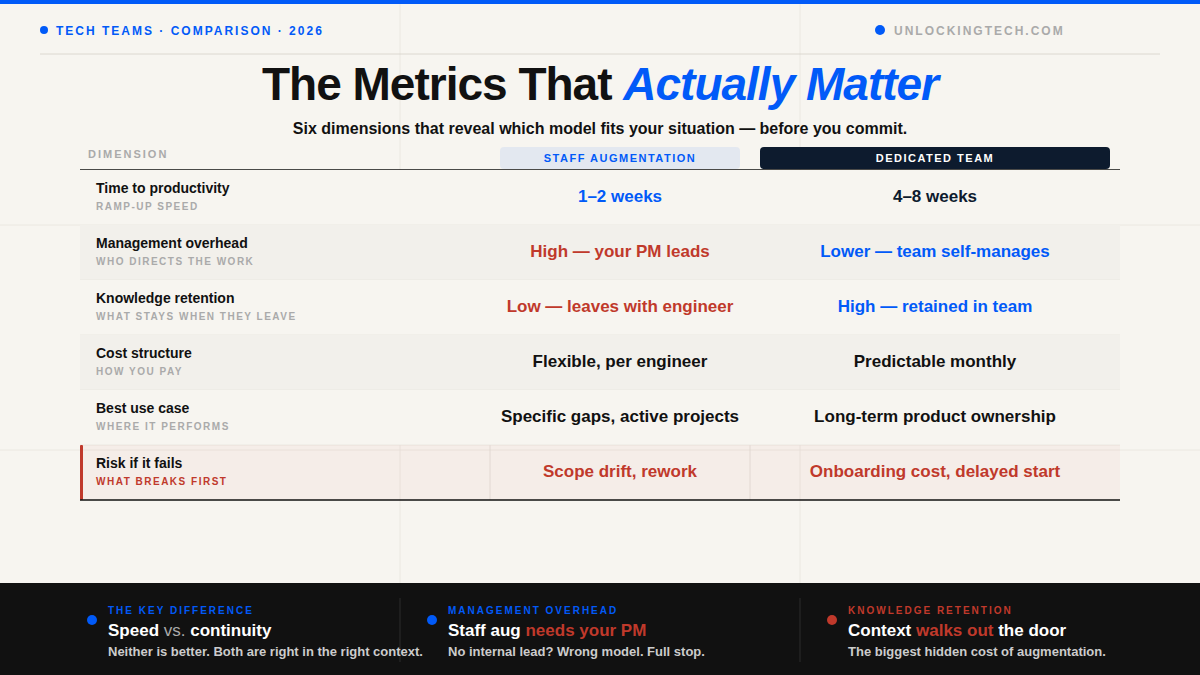
Speed of access is the primary advantage. A well-run staff augmentation provider can place a qualified engineer within one to three weeks. For teams facing an active project with a near-term deadline, that speed has real commercial value. A dedicated team, by contrast, requires a longer setup process — defining the team composition, onboarding, establishing working rhythms — which makes it the wrong instrument for an urgent, short-term need.
Flexibility is the second advantage. Staff augmentation scales up and down with your actual project demand. You can add three engineers for a product sprint, reduce to one during a stabilisation period, and scale back up for the next release cycle. This flexibility is particularly useful for companies with variable workloads, seasonal demand, or projects that are still in scope-definition phase. You are not committing to a team structure before you know what you need.
Minimal contractual complexity is the third. Because augmented engineers integrate into your existing structure, the commercial arrangement is relatively simple — typically a monthly rate per engineer with a defined notice period. There is no shared ownership of deliverables, no ambiguity about who manages what, and no long-term commitment that becomes difficult to exit if the project changes direction.
That said, these advantages are only realised when your internal structure is genuinely capable of absorbing external talent. In practice, the companies where augmentation works best share a common profile: a functioning technical lead who has bandwidth to direct new engineers, a codebase with enough documentation to onboard without months of tribal knowledge transfer, and a project scope that is specific enough to brief clearly. When those conditions are absent, the speed advantage of augmentation gets consumed by the overhead of integration — and what looked like a fast solution becomes a slow one with additional complexity.
Knowledge loss at exit is the structural weakness of the model. Augmented engineers leave when the engagement ends, and their understanding of your system, your edge cases, and your architectural decisions leaves with them. If you have used augmented engineers to build significant components of your product, you may find yourself with a codebase that your internal team does not fully understand — and that the next engineer you bring in will need time to reverse-engineer. This is not a hypothetical risk; it is the most consistent failure mode companies report after augmentation engagements that ran longer than originally planned.
Dependency on internal management capacity is the second weakness. The model assumes you have a technical lead capable of onboarding, directing, and reviewing the work of external engineers. In companies where that capacity is limited or already fully occupied, augmented engineers tend to operate with insufficient direction, produce work that requires significant rework, or default to their own technical preferences rather than yours. The cost of that misalignment tends to appear in the form of technical debt that is invisible until you try to scale the system.
Cultural and process friction is the third. Augmented engineers are working across multiple clients, maintaining their own working habits, and operating within your structure as temporary participants. This is not a character flaw; it is a structural reality of the model. It means that process adherence, code quality standards, and architectural consistency require active management rather than emerging naturally from team culture. The implication is straightforward: the more augmented engineers you have relative to your internal team, the more management capacity you need to absorb them effectively. Companies that treat augmentation as a way to scale without proportionally scaling their internal technical leadership tend to discover this at the worst possible moment — mid-sprint, with a deadline approaching and a codebase that nobody fully owns.

Accumulated context is the primary advantage — and it compounds. A dedicated team that has worked on your product for six months understands your system at a depth that cannot be replicated by onboarding new engineers, however talented. They know which parts of the codebase are fragile, which architectural decisions were made under constraint, and which product requirements are likely to change. That knowledge translates directly into faster, more accurate delivery over time.
This advantage is most pronounced — and most critical — in AI-integrated environments, where model performance drifts over time, data pipelines require ongoing maintenance, and edge cases emerge months after deployment. Managing an AI system correctly requires engineers who understand not just the code but the history of decisions that shaped it. A rotating cast of augmented engineers is structurally unsuited to that task. If your environment includes AI agents, RAG systems, or automated decision workflows, the dedicated team model is not just preferable — it is the only one that reliably catches the problems that matter before they become production failures.
Reduced management overhead is the second advantage. A well-constituted dedicated team — with its own technical lead — manages itself within the agreed scope. You define the product direction and the outcomes. The team handles the technical decisions, the day-to-day coordination, and the delivery. For founding teams or leadership teams without strong internal technical capacity, this is often the only model that allows them to build serious technical capability without hiring a full internal engineering team immediately.
Incentive alignment is the third. A dedicated team's commercial arrangement creates structural incentives to invest in code quality, documentation, and system maintainability. They are accountable for the system they build because they will continue to work with it. This is the opposite of the incentive structure in short-term augmentation, where engineers have limited personal stake in the long-term quality of what they deliver. According to McKinsey's research on large-scale software projects, cross-functional teams with end-to-end ownership of application modules consistently improve cost, quality, and speed by providing more accountability and better coordination. This alignment is central to how Unlocking Tech approaches nearshore dedicated teams from Portugal — accountability extends beyond delivery, not just to it.
It is also worth noting that nearshore dedicated teams — particularly from Portugal — make the minimum commitment argument considerably more accessible. The cost structure of a nearshore engagement at Western European quality standards means that the three-to-six-month minimum that would be prohibitive with an onshore team becomes a reasonable investment for a much wider range of companies. For European businesses evaluating dedicated teams for the first time, this is often the factor that makes the model viable rather than aspirational.
Longer ramp-up is the primary constraint. Assembling a dedicated team, onboarding them to your context, and reaching full productivity typically takes four to eight weeks. For companies with an immediate, defined need, that timeline is prohibitive. The model is not designed for urgency; it is designed for sustained delivery.
Higher minimum commitment is the second constraint. A dedicated team engagement rarely makes economic sense below three to six months. The setup cost — both commercial and operational — is only justified when there is sufficient ongoing work to amortise it. Companies that engage a dedicated team for a short project typically find that the onboarding cost consumes a disproportionate share of the value delivered.
Dependency on team stability is the third. The accumulated context that makes dedicated teams valuable is also what makes personnel changes costly. If the team loses its technical lead or a senior engineer mid-engagement, you lose the knowledge that was concentrated in those individuals. A well-run dedicated team provider will have continuity processes — documentation, pair working, structured handovers — but this risk is real and should be explicitly addressed in any commercial arrangement. This is worth asking about directly before signing: what is the provider's process when a team member leaves? The quality of the answer tells you a great deal about how seriously they have thought through the full lifecycle of the engagement.
Many companies of meaningful scale end up using both models simultaneously, and this is often the right answer — provided the distinction between them is maintained deliberately rather than allowed to blur. A common pattern is a dedicated team owning the core product, augmented by specialists for specific capabilities that fall outside the core team's expertise: a security specialist during a compliance audit, a data engineer for a specific pipeline build, or a mobile developer for a platform extension.
The failure mode in hybrid arrangements is treating augmented engineers as temporary additions to the dedicated team rather than as external specialists with a defined scope. When that boundary is unclear, augmented engineers start absorbing context that belongs in the dedicated team, creating knowledge fragmentation rather than resolving it. The rule of thumb is simple: augmented engineers should have a specific, bounded scope that can be clearly handed back to the dedicated team at the end of the engagement. If you cannot define that scope before the augmented engineer starts, you are not ready for augmentation — you are trying to solve an unclear problem with additional headcount, which tends to make the problem more expensive rather than smaller.
When AI systems are involved, this boundary becomes even more important. Augmented engineers joining an AI-integrated environment for a short engagement will rarely accumulate enough context to manage it safely — and may introduce problems that only surface months later. If your core product includes AI components, treat the dedicated team as the owner of that domain and use augmentation only for clearly bounded, non-AI work that can be handed back cleanly.
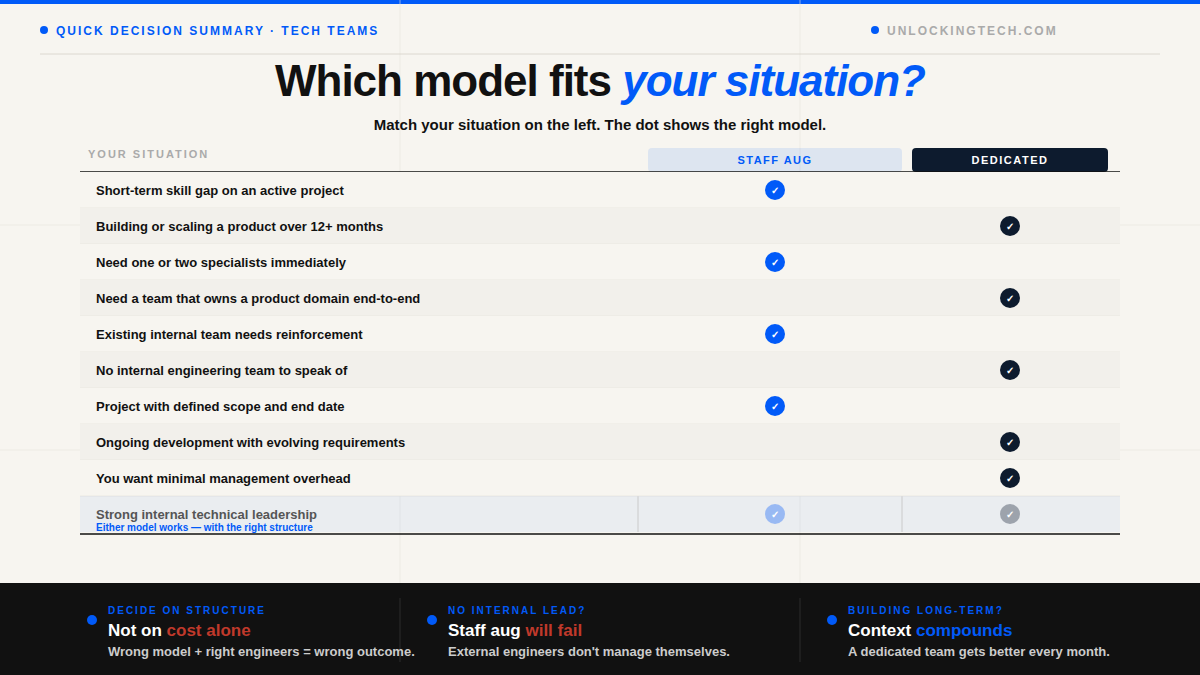
Use staff augmentation when:
- You have a specific, defined skill gap on an active project with a near-term deadline
- Your internal team is functional and has the technical leadership to direct and absorb external talent
- The engagement has a clear end point — a product launch, a feature release, a migration
- You need one or two engineers, not a team
- Flexibility and speed of access matter more than continuity
Use a dedicated team when:
- You are building or scaling a product over twelve months or more
- You do not have strong internal technical leadership to direct augmented engineers
- Knowledge retention and accumulated context are genuine competitive advantages for your project
- You want a team that owns a domain and is accountable for outcomes, not just delivery
- The scope is expected to evolve and requires a team that can adapt with it
- Your environment includes AI systems, automation workflows, or models in production — where accumulated context is not just useful but essential for safe management
Consider neither when your problem is diagnostic, not executional.
Both staff augmentation and dedicated teams are delivery instruments. They are designed to execute work that has already been defined. If you are in a situation where the technology does not match the business, where systems are disconnected, where AI needs to be built into operations rather than bolted on top of them, or where the fundamental architecture of what you have inherited is the source of the friction — neither model will solve that. You will be adding engineering capacity to a problem that requires engineering judgment, which tends to make the problem more expensive rather than smaller.
This is particularly true for companies at the intersection of AI and operations. The question of whether to augment or build a dedicated team becomes secondary when the real problem is that nobody has defined what the AI system should actually do, what success looks like, or how the existing processes need to change to absorb it. Dropping engineers into that environment — of either model — produces a system that works technically and a business that did not change. That is the most expensive outcome possible, because nobody can point to what went wrong.
The companies that get the most value from either model are the ones that arrive with a clear diagnosis: they know what they need to build, they know why, and they have defined what success looks like. When that clarity is missing, the first investment is in getting it — not in headcount. At Unlocking Tech, every engagement starts with a diagnostic phase for exactly this reason. We have seen too many companies sign a staff augmentation or dedicated team contract before understanding what they actually needed, and the cost of that sequence error is almost always higher than the cost of taking two weeks to define it correctly. If you are not sure which category your situation falls into, that conversation is worth having before you hire anyone.
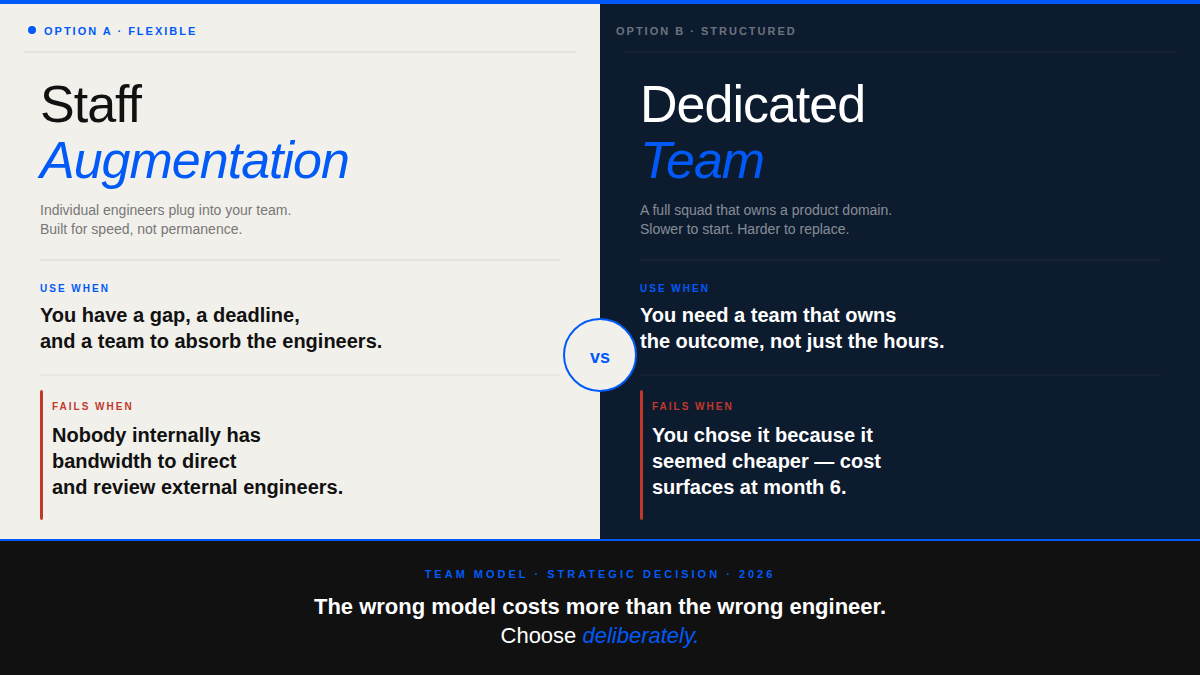
The choice between staff augmentation and a dedicated team is a structural decision, not a commercial one. Framing it primarily as a cost question leads to the wrong answer in most cases — because the cost of choosing the wrong model tends to exceed any short-term savings from choosing the cheaper option.
The more useful frame is: what does success look like at month twelve, and which model is structurally designed to produce that outcome? Staff augmentation produces speed and flexibility at the cost of continuity. Dedicated teams produce continuity and depth at the cost of speed and minimum commitment. Neither is superior in the abstract. Both are right in the right circumstances.
If you are ready to make this decision and want a second perspective before committing, speak with our team. We will give you a direct answer based on your specific situation — not a proposal.