

Managed IT Services Pricing: What to Expect in 2026

Managed IT services pricing is rarely primarily a cost problem. It tends to be a scope definition problem, and companies that focus on the monthly number instead of what the contract actually commits to are solving the wrong thing.
The monthly fee is the last variable that should drive your decision, not the first. Yet it is almost always the first. A company receives two proposals (one at €4,500/month, one at €7,200/month) and begins negotiating the gap without having established whether the cheaper one covers what the business actually needs, or whether the more expensive one is charging for services that will never be used. The result of that negotiation is almost always a contract that was optimised for a number rather than an outcome, and those contracts have a predictable trajectory: friction within six months, renegotiation within twelve, and either a difficult exit or a relationship that limps forward on resentment.
This article makes the case for a different sequence: understand what you are buying before you discuss what it costs. If you are also evaluating whether managed IT services is even the right model for your situation, versus a digital transformation partnership or building in-house capability, the framework here will help you make that distinction as well.
- Quick Decision Summary
- What the Market Actually Looks Like in 2026
- The Four Tiers of Managed IT and Why Bundling Them Is a Problem
- The Pricing Models and What Each One Actually Incentivises
- What Actually Drives the Price Up or Down
- The Hidden Costs That Rarely Appear in Proposals
- What a Genuinely Useful Proposal Contains
- When to Use Each Pricing Model
- Frequently Asked Questions
- Closing Note
Quick Decision Summary
| Your Situation | What This Means for Pricing |
|---|---|
| Standardised stack, stable team, primary need is helpdesk support | Per-user model is efficient: €40–€120/user/month |
| Complex or AI-integrated environment | Flat retainer with explicit, exhaustive scope definition |
| Scaling rapidly, headcount changing | Per-user with pre-agreed escalation mechanisms written into the contract |
| Transformation underway, not just maintenance | A managed services provider is likely the wrong model entirely |
| Critical uptime requirements, revenue-tied systems | 24/7 SLA with contractual remedies; expect a 30–60% premium |
What the Market Actually Looks Like in 2026
The managed services market is large and growing, estimated at over $430 billion globally in 2026, expanding at roughly 10% annually, and that scale has produced an important structural consequence: enormous variation in what providers are actually selling under the same label. A company describing itself as a "managed IT services provider" in 2026 might be offering 24/7 infrastructure monitoring with a senior engineering team, or it might be offering a shared helpdesk that responds to tickets within two business days. Both are technically managed services. The pricing gap between them is real and justified. The problem is that the label alone tells you nothing about which you are getting.
This variation is compounded by the fact that the market has changed significantly in the past two years. According to CompTIA's IT Industry Outlook 2026, 84% of business and technology professionals anticipate a significant or moderate increase in AI investments over the coming year, which means managed services providers are under pressure to incorporate AI capabilities into their offerings, and many are doing so at very different levels of maturity. Some providers have genuinely integrated AI into their monitoring, triage, and remediation workflows. Others have added "AI-enabled" to their marketing without meaningfully changing their delivery. Your ability to distinguish between them determines whether you get the premium you are paying for.
The practical implication is this: before you evaluate pricing, you need to evaluate what is being priced. The taxonomy below is the starting point.
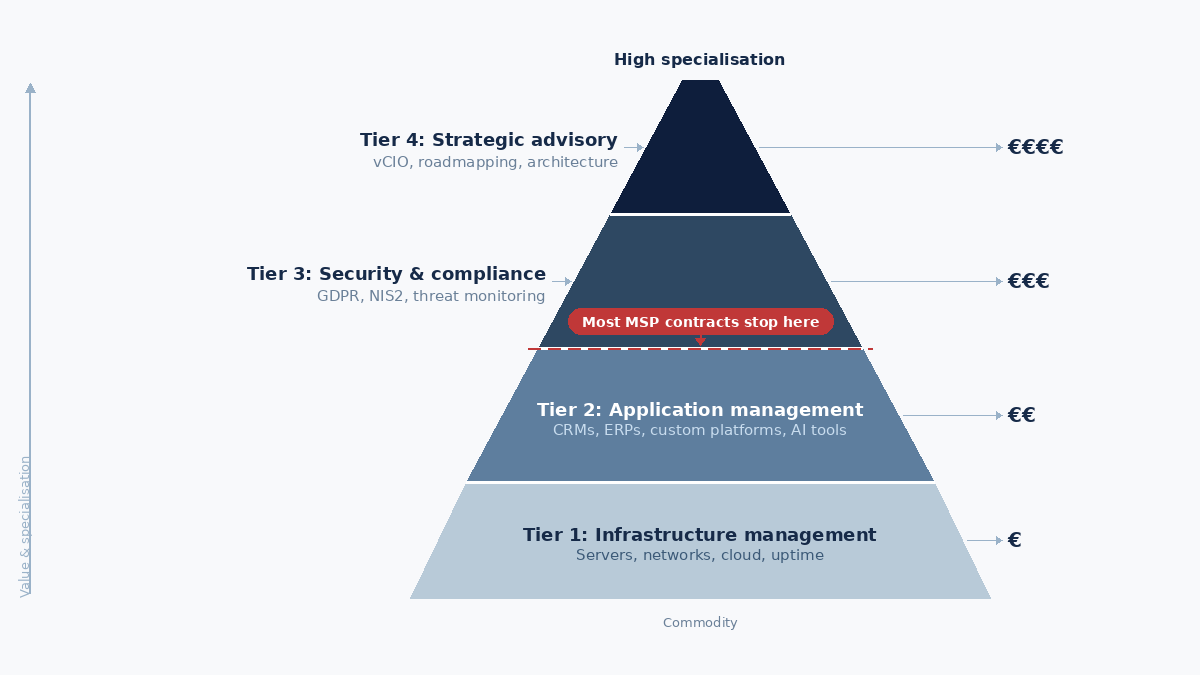
The managed IT services market is built on four distinct layers of work, each with different skill requirements, different cost structures, and different levels of market competition. Understanding them separately is the prerequisite for evaluating any proposal intelligently.
The first and oldest layer is infrastructure management: server maintenance, network monitoring, cloud environments, uptime guarantees. This is the most commoditised segment of the market, which is why pricing here has stabilised and competition is most intense. Per-user and per-device models were designed for this layer, and they function reasonably well within it.
The second layer is application management, which covers the systems your business actually runs on: CRMs, ERPs, custom-built platforms, and increasingly AI-powered tools integrated into operational workflows. This layer requires providers to understand your specific systems, not just generic infrastructure, which is why it commands higher rates and why providers who lack the depth to deliver it tend to underprice it during the sales process and surface the gap afterwards.
The third layer is security and compliance, which has become a distinct category in the European market driven by two converging forces. GDPR enforcement has intensified, and the NIS2 directive (which came into effect in 2024) has substantially expanded cybersecurity obligations for a much broader range of organisations than its predecessor. According to a 2024 Gartner forecast on security spending, managed security is among the fastest-growing segments of the entire IT services market, which reflects both genuine demand and the premium pricing it commands. A provider who bundles security into a flat infrastructure fee is either not delivering genuine security management or cross-subsidising it at the expense of another service line.
The fourth layer is strategic advisory: vCIO functions, technology roadmapping, vendor evaluation, and architecture decisions. It represents the highest-value tier and the most frequently oversold one. Providers who promise "strategic partnership" in a proposal and deliver quarterly check-in calls in practice are selling this tier without delivering it. The distinction matters because you are paying for it either way.
The practical implication of this taxonomy is direct: a proposal that bundles all four layers into a single monthly figure makes it structurally impossible to know what you are buying, which makes it structurally impossible to know whether the price is fair. The first question to ask of any proposal is not "how much?" but "what, precisely, does this cover at each layer, and what does it explicitly not cover?"
The Pricing Models and What Each One Actually Incentivises
1. Per-user pricing
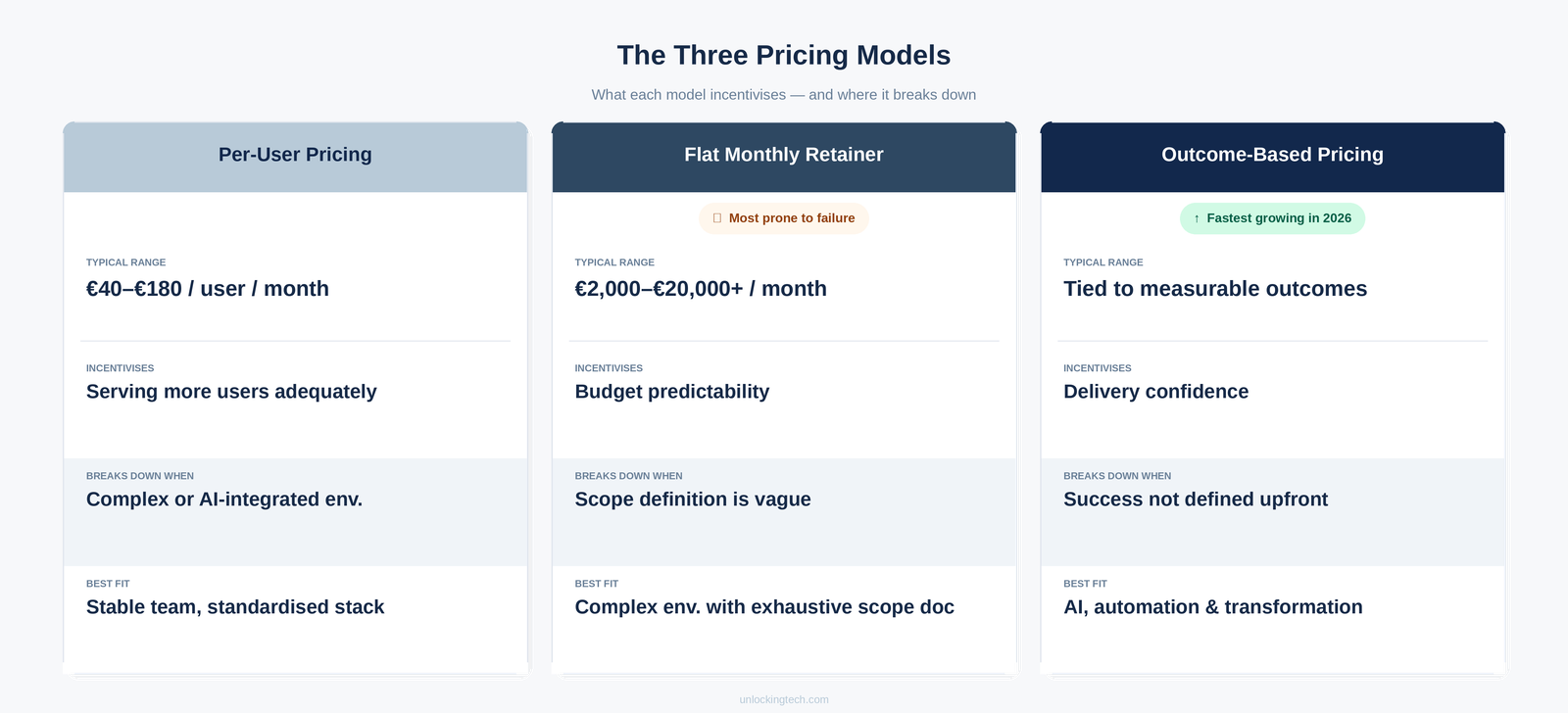
The most widely adopted model in the mid-market, per-user pricing charges a fixed monthly fee for each employee covered under the agreement. In the European market in 2026, this typically ranges from €40 to €180 per user per month, with the variation driven by support tier, coverage hours, and whether security services are included or priced separately.
This model works well when the primary need is endpoint management, helpdesk support, and standardised tooling across a stable workforce. It scales predictably as headcount grows. The structural limitation, however, is worth naming clearly: per-user pricing incentivises providers to serve more users adequately rather than fewer users exceptionally well. The economics reward breadth. For companies with complex systems, non-standard environments, or AI integrations, this model tends to underprice what is genuinely required, and the gap between what was priced and what is needed only becomes visible when something goes wrong.
2. Flat monthly retainer
A fixed monthly fee covering an agreed scope of services, regardless of volume. This is the model that attracts the most interest from leadership teams because it offers budget predictability, and it is also the model most prone to structural failure. Not because the model is flawed, but because scope definition is almost always inadequate.
Flat retainers in the European mid-market range from €2,000 to €20,000+ per month, with the variation driven almost entirely by scope precision, team seniority, and the technical complexity of what is being managed. The number itself tells you almost nothing without the scope document that sits behind it. Vague language like "general IT support" or "system maintenance" in a flat retainer contract is not a minor drafting issue. It is a contractual mechanism that allows the provider to interpret scope narrowly when inconvenient and the client to expect broadly when it suits them. The result is a relationship defined by ongoing negotiation over what is included, which is the exact opposite of what a retainer is supposed to produce.
A flat retainer only delivers what it promises when the scope definition is exhaustive: what systems are covered, what response times are guaranteed for which severity levels, what is explicitly excluded, and what the mechanism is for handling work that falls outside the defined scope.
3. Outcome-based and value-based pricing
The fastest-growing model in 2026, particularly in engagements that involve AI, automation, or genuine transformation rather than pure maintenance. Rather than charging for time or assets managed, outcome-based pricing ties fees to measurable results: system uptime guarantees with financial remedies when missed, reduction in manual processing hours, or specific business metrics the technology is meant to move.
This model requires considerably more sophistication from both sides. The provider needs genuine confidence in their delivery capability. The client needs to have defined what success looks like, in measurable terms, before the contract is signed. Providers who resist outcome-based elements in their proposals are often signalling, consciously or not, that they have limited confidence in the results they will deliver. That signal is worth taking seriously.
At Unlocking Tech, the diagnostic-first approach that underpins our AI automation services and transformation engagements reflects this same logic: the outcome has to be defined before the work begins, because a system that was built without a clear definition of success has no reliable way to know whether it worked. This principle is detailed further in our development philosophy.
What Actually Drives the Price Up or Down
The complexity of your current environment is the single largest cost driver, and it is almost always underweighted in the buyer's initial evaluation. A company running standardised SaaS tools on a clean, documented stack is genuinely cheaper to manage than one running a combination of legacy systems, custom-built applications, undocumented integrations, and AI tools that were added without coherent architecture. Providers who do not conduct a thorough technical assessment before quoting are either underestimating the work or planning to surface scope creep later. Both outcomes cost you money.
Coverage hours and response time SLAs have a direct and quantifiable impact on price. Maintaining an on-call engineering team around the clock requires real staffing investment, and that investment is either built into the retainer or absent from the service. For companies where downtime has direct revenue consequences (e-commerce operations, financial services platforms, healthcare systems) the premium for genuine 24/7 coverage with sub-one-hour response SLAs is typically 30–60% above business-hours equivalents. The question is not whether that premium is high; it is whether the alternative cost of downtime justifies absorbing it.
AI system management is a meaningful and growing cost variable in 2026. AI-integrated environments require more active monitoring than traditional software: model performance drifts over time, data pipelines need ongoing maintenance, and edge cases that were not present at deployment emerge in production environments. There is also a significant shortage of providers who can genuinely manage AI agents and RAG systems rather than simply maintain infrastructure around them. Scarcity drives price, and it also drives risk. A provider who lacks genuine AI competence and manages an AI system as if it were standard software will miss problems that a competent provider would catch. If your environment includes AI-powered workflows, ensure that any managed services proposal addresses these components explicitly, with named engineers who have relevant experience, not just a line item.
Team location and delivery model affects cost substantially. Nearshore managed services from Portugal, which has developed into a significant engineering hub for the broader European market, typically offer a 30–50% cost advantage over equivalent onshore providers in Western Europe, without the communication overhead or time zone friction of offshore delivery. If you are evaluating specific providers, our breakdown of nearshoring versus offshoring versus onshoring covers the decision criteria in detail, including what to look for when assessing whether a provider's nearshore claim reflects genuine local delivery capability or simply a sales label.

The Hidden Costs That Rarely Appear in Proposals
1. Onboarding and transition costs are almost never included in the monthly fee quoted during a sales process, yet they are real and material. Moving from one managed services provider to another, or from self-managed IT to an external provider, requires documentation, system access reviews, knowledge transfer, and often a period of parallel operations to reduce risk during cutover. Depending on environment complexity, this can represent one to three months of additional cost and internal resource investment. Any proposal that does not address the onboarding process and timeline in detail is leaving this cost invisible, which means you will absorb it later without having planned for it.
2. Scope escalation is the second hidden cost, and the most structurally predictable one. As your business changes (new tools adopted, headcount growing, AI systems added, compliance requirements evolving) the scope of what needs to be managed grows with it. Providers who priced narrowly to win the initial engagement tend to recover margin through scope escalation charges as that growth occurs. The mitigation is contractual: pre-agreed mechanisms for scope changes, such as fixed rates for defined categories of additional work or quarterly review windows where scope is formally reassessed, rather than open-ended "additional work at standard rates" language that gives the provider unilateral pricing power over anything outside the original definition.
3. Exit costs and data portability are the third category, and arguably the most consequential because they affect your negotiating position for the entire duration of the relationship. Transitioning away from a managed services provider should be straightforward: your systems, your data, your documentation, a defined transition period. In practice, it often is not. Providers who have not built clean handover processes into their delivery model have limited incentive to make departures easy, and a contract that is silent on offboarding terms leaves you with no leverage when the relationship ends. Before signing, ask specifically: what does offboarding look like, what documentation will we receive at exit, and what is the minimum transition support period? The quality of the answer tells you a great deal about how the provider thinks about the full lifecycle of the engagement, not just the sale.
These three cost categories (onboarding, escalation, and exit) are not accidents or oversights. They are the predictable consequence of engaging a provider without having established the full lifecycle of the relationship upfront. At Unlocking Tech, accountability does not end at go-live; it is structured into the engagement from the diagnostic phase forward. If you want to understand the wider pattern of how outsourcing engagements fail, our article on the easiest way to fail in outsourcing covers the sequence of mistakes we see most consistently.
What a Genuinely Useful Proposal Contains
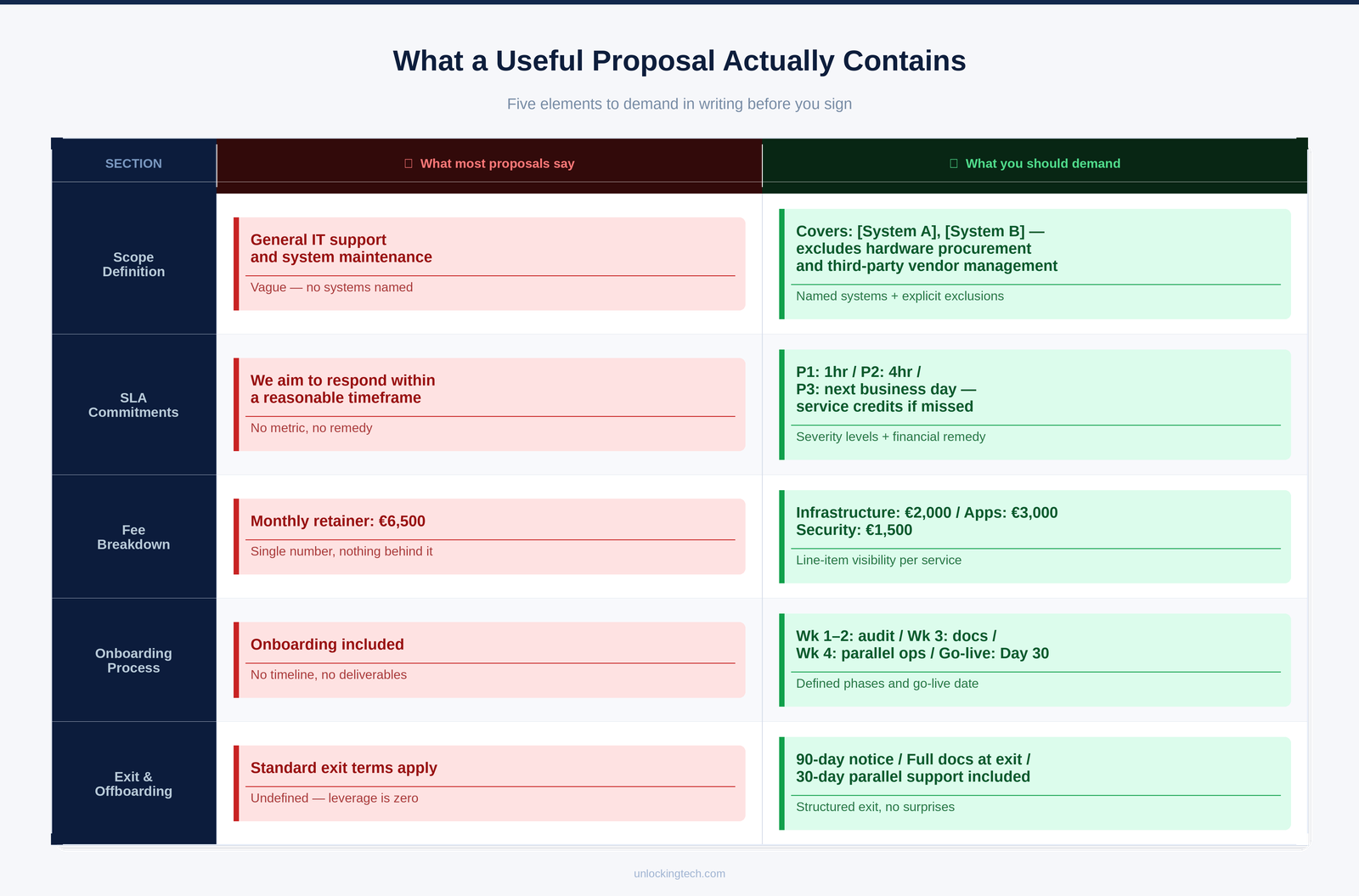
Most managed IT services proposals are structured to make the provider look capable and the client feel reassured. A proposal that is actually useful for decision-making looks different: it is specific enough to be held accountable to.
Concretely, this means the scope document defines covered systems by name, not categories. It means SLA commitments specify response times by severity level and include financial remedies (service credits, fee reductions) when those times are missed, not just a promise to try harder. It means the fee breakdown shows what each component costs, so you can assess whether you are paying for services you actually need.
It also means onboarding is described as a process with a named timeline, not a phrase at the end of a proposal. And it means the exit process is documented before you sign, not negotiated after you decide to leave, when your leverage is at its lowest.
If a proposal is thin on any of these elements, it is worth asking why directly and treating the answer as information about how the provider operates, not just how they sell. The absence of detail in a proposal is almost always preserved as ambiguity in the contract. Ambiguity in the contract becomes conflict in the relationship. At Unlocking Tech, this is why our AI consulting engagements begin with a diagnostic phase that produces a precise scope definition before any commercial terms are discussed, because clarity at the start is cheaper than renegotiation in the middle.
When to Use Each Pricing Model
Use per-user pricing when your environment is standardised, your headcount is stable or growing predictably, and the primary need is endpoint management and helpdesk support. This model is efficient and scales well under those conditions. It tends to break down the moment your environment becomes complex, non-standard, or AI-integrated, because the economics stop reflecting the real cost of delivering the service.
Use a flat monthly retainer when you have a complex or bespoke environment and need predictable costs, but only if the scope definition is exhaustive. A flat retainer with vague scope language is not predictability. It is deferred conflict. The contract must name the systems covered, the severity levels and response times for each, the exclusions, and the mechanism for handling out-of-scope requests. Without those four elements in writing, a flat retainer is a liability disguised as a budget line.
Use outcome-based or value-based pricing when the engagement involves AI, automation, or transformation, where the value being created is measurable and the provider should have genuine confidence in delivering it. This model is also the clearest signal of provider maturity: a provider who proposes outcome-based terms is one who has thought through the full lifecycle of the engagement. A provider who resists it is one who has not.
Consider none of the above when what you actually need is transformation, not maintenance. If your systems need to be redesigned, if AI needs to be built into your operations rather than managed around them, or if your primary problem is that the technology does not match the business, a managed services engagement is unlikely to solve that. A strategic partner who takes accountability for outcomes, not just uptime, is the right model.
What is a realistic budget for managed IT services for a 50–150 person company in Europe in 2026?
For a company of this size with a moderately complex stack and business-hours coverage, expect a realistic range of €4,000–€12,000 per month depending on scope, the inclusion of security services, and provider seniority. Per-user pricing for the same organisation typically lands at €60–€140 per user per month at the mid-tier. These ranges assume a well-defined scope. An undefined scope with the same team size can cost significantly more or deliver significantly less.
How do I know if a proposal is priced fairly?
A fair price is one you can trace to what is being delivered. If the proposal does not break down the fee by service component, you cannot assess fairness. You can only compare the total against other totals, which tells you nothing about quality or fit. Ask for a line-item breakdown. If the provider resists, that resistance is informative.
Is cheaper always worse?
Not necessarily, but it is always worth understanding what was removed to reach the lower price. The most common cuts are coverage hours, response time SLAs, and team seniority. Whether those cuts matter depends entirely on your environment and risk tolerance. A company with non-critical internal tooling and a small team may find that business-hours-only support from a junior team is entirely sufficient. A company whose revenue systems run on a custom platform with AI integrations cannot afford that trade-off.
How does managed IT services pricing change when AI systems are involved?
AI-integrated environments typically attract a 20–40% premium over equivalent traditional IT environments, reflecting the additional monitoring complexity, model maintenance requirements, and specialist knowledge required. Providers who quote AI system management at the same rate as standard software management either have not understood the scope or are underestimating the work, and both outcomes become your problem after go-live.
What is the difference between a managed services provider and a transformation partner?
A managed services provider maintains and supports what exists. A transformation partner changes what exists by redesigning systems, integrating AI, building new capabilities, and taking accountability for whether those changes produce business results. Many companies need both at different stages, but they are structurally different engagements with different commercial models. Signing a managed services contract when what you need is a transformation partner is one of the more expensive mismatches in technology procurement.
How long should a managed IT services contract be?
Most providers structure initial engagements at 12 months minimum, with 24-month terms increasingly common as the value of continuity in AI and automation environments grows. The more important variable than length is the exit mechanism: a 12-month contract with a punitive exit clause offers less flexibility than a 24-month contract with a clean 90-day termination provision. Read the exit terms before you negotiate the term length.
What should I do if I am already in a managed services contract that is not working?
Start by documenting specifically what is not working against the contract's stated SLAs and scope. This creates a factual basis for renegotiation rather than a complaint. If the contract includes a performance remedy clause, invoke it formally in writing. This creates a record and often produces a faster response than informal escalation. If the relationship is genuinely broken and the contract allows exit, begin transition planning before formally triggering the exit process. Running parallel with a new provider for a defined period reduces risk during cutover considerably.
How do I know if I am overpaying?
The clearest signal is a persistent mismatch between what the contract commits to and what you are receiving. Secondary signals include: response times that consistently exceed the stated SLA without formal remedy being applied; support interactions that require escalation for recurring issues that were previously resolved; and a provider who has not proactively suggested any improvements to your environment in the past two quarters. A provider charging for a strategic relationship and delivering reactive support is collecting a premium they have not earned.
Closing Note
The companies that overpay for managed IT services are rarely making a single dramatic mistake. They are making a sequence of smaller ones: accepting vague scope definitions because the conversation felt collaborative, not reading the SLA remedy clauses because the relationship felt strong, choosing a provider based on a lower monthly number without understanding what was removed to reach it. The pattern is consistent enough that it suggests the problem is not due diligence. It is the sequence in which decisions are made.
Price last. Define scope first, establish SLAs with real remedies second, understand the exit terms third. The monthly number that results from that sequence will be one you can actually evaluate.
If you are approaching a managed IT services decision and want a second perspective on what your environment actually requires, before you review proposals, speak with our team. We will help you define what good looks like for your specific situation, so you can evaluate what you are being offered against a standard that belongs to you, not to the provider.