
Custom computer vision solutions, developed on the images your business already collects.
We're a computer vision software development company: we build custom computer vision solutions — object detection, OCR, defect detection, visual search and video analytics — trained on your images and deployed where you need them, on the edge or in the cloud.
What are custom computer vision solutions?
Custom computer vision solutions are systems that read images and video and act on what they see — detecting and counting objects, spotting defects on a line, reading text from photos and scans (OCR), matching and searching by image, and monitoring a feed for the thing you care about. We build them custom, around your cameras, your data and your accuracy bar, rather than reselling a generic vision model.
Our computer vision development services span object detection and recognition, image and video analysis, OCR and document capture, and visual inspection — deployed on the edge for low latency or in the cloud for scale. It's the same engineering behind our AI agents and custom AI development work, pointed at pixels instead of text.
Computer vision use cases we build
Quality control and defect detection on a production line; counting, tracking and measuring objects; OCR and document capture from photos and scans; image classification and visual search over a product catalogue; safety and site monitoring from cameras you already have; and analysis of drone, satellite or microscope imagery — across manufacturing, logistics, retail, agriculture and healthcare. Each one starts from the decision the images should drive, not from the model.
How we develop a custom computer vision model
Collect and annotate a representative image set, hard cases included — bad light, occlusion, rare defects. Start from a pre-trained model (YOLO for detection, PyTorch or TensorFlow backbones, OpenCV for the classical steps) and fine-tune it on your data. Measure precision and recall per class on held-out images, set a confidence threshold below which a person reviews, then deploy — quantised on edge hardware or served from the cloud — with monitoring as cameras, lighting and products change.
Computer vision consulting: is your problem ready for it?
Before training anything, we check whether the cameras can actually see what you need — resolution, angle, lighting — whether you have, or can collect, enough labelled examples of the rare cases, and what error rate the process tolerates. Sometimes the right answer is a better light or a fixed rule in OpenCV, not a deep learning model; computer vision consulting that ends there is still a good outcome.
How much does a computer vision project cost?
Fixed price, agreed after scoping: most of our custom AI projects start between €15k and €50k, and a first production computer vision workflow typically takes 2 to 4 weeks. What drives the number is annotation volume, the number of classes and how varied your camera conditions are, plus edge hardware if inference has to run on site. After launch, the running cost is inference, sized on your real image volume before go-live.
A computer vision partner in your time zone
Our engineers are in Lisbon, an hour behind CET, so teams in Amsterdam, Brussels or Munich get a full overlapping working day with a partner inside the EU. Images stay in-region where required, and when cameras capture people we treat the footage as personal data under GDPR from the first design decision — blurring, retention limits, access control — instead of retrofitting it before launch.
We deliver computer vision solutions that turn images and videos into actionable insights—powering quality control, visual search, facial recognition, and intelligent monitoring systems.
From object detection to OCR and generative image models, we design systems for edge or cloud deployment, helping businesses automate visual tasks with precision and reliability.
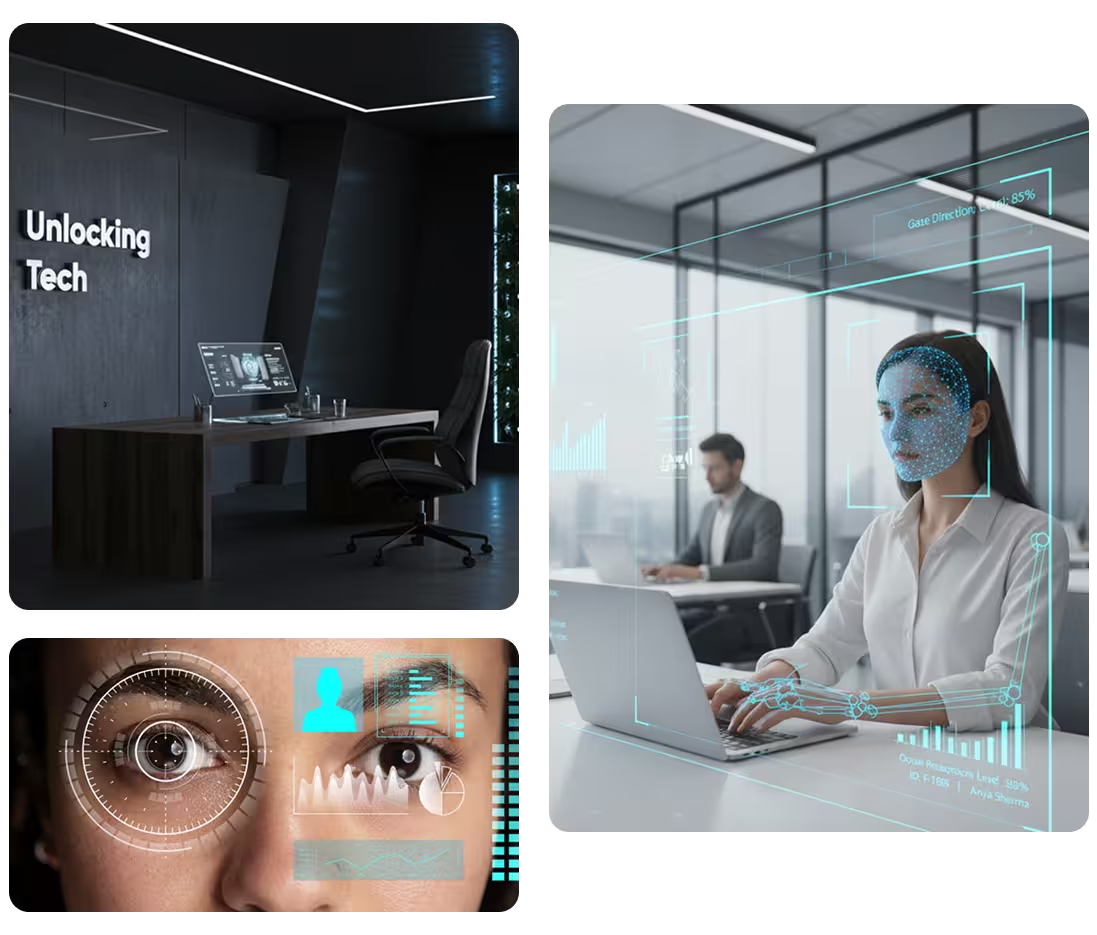
Implement computer vision algorithms to detect and recognize objects in images and videos, enhancing security, quality control, and analysis.
Use advanced facial recognition technologies to improve security measures, customer experience, and personalized services.
Extract insights from images and videos, enabling smarter automation, surveillance, and data processing in various business sectors.
Use computer vision to create AR experiences that provide real-time information or interactive experiences for customers or employees.
We map your current workflow and identify the highest-impact build.
Architecture and scope, fixed before we write production code.
Senior engineers ship week by week, with a demo every Friday.
Measured against the metric we agreed on — and tuned until it holds.
Computer vision is AI technology enabling machines to interpret and analyze visual information from images and videos. Using deep learning and neural networks, computer vision systems recognize objects, detect patterns, measure dimensions, and extract insights from visual data. Applications span quality control, surveillance, medical imaging, and autonomous systems.
Popular computer vision applications include quality control in manufacturing (defect detection), retail analytics (customer behavior, inventory tracking), medical imaging (diagnostics), security surveillance (facial recognition), autonomous vehicles (object detection), and document processing (OCR). We start with the use case that has the clearest return and prove the accuracy on your own images first.
Yes. Computer vision models extract text (OCR), identify and count objects, measure dimensions, detect defects and classify images — and on narrow, well-defined tasks they can match a trained person while working faster and without fatigue. How accurate they are on your images depends on image quality and the examples available, so we measure it on held-out images of your own before anything runs unattended.
Our computer vision services process diverse visual data including photos, medical scans, 3D models... We handle real-time processing (video surveillance, quality control) and batch analysis (medical imaging). Solutions work with standard cameras, specialized sensors, drones, and industrial imaging equipment.
A first production computer vision workflow — object detection on one camera setup, for example — typically takes 2 to 4 weeks; complex custom models take longer. Factors include data availability, accuracy requirements, integration needs, and processing infrastructure. Our proven methodologies and pre-trained models accelerate development while ensuring production-grade accuracy and performance.
Computer vision solutions and services are custom systems that turn images and video into decisions — object detection, OCR, defect detection, visual search and monitoring — built around your cameras and data. Unlike a generic vision API, they're tuned to your accuracy bar and deployed where you need them, on the edge or in the cloud.
Common wins: automated quality control and defect detection on a production line, counting and tracking objects, reading text and fields from photos and scans (OCR), visual search over a catalogue, and monitoring a camera feed for safety or operations. We start with the one use case with the clearest return and prove the accuracy before it runs unattended.
Both: latency-sensitive inspection runs on the edge, large-scale analysis in the cloud. On accuracy, we measure against your real images and set a threshold below which a person reviews — we don't ship a model that quietly guesses. The honest number depends on your images, and we prove it on your data before launch.
Two to four weeks for a first production computer vision workflow at a fixed price, proven against your real images. No per-seat platform fee — you own the system and your only running cost is inference, because we build around your stack rather than a closed product.
AI Consulting services providing expert AI strategy, implementation, and optimization to accelerate ROI and deliver scalable artificial intelligence solutions.
Know more→AI model development and machine learning consulting: custom models for prediction, classification and forecasting, trained on your data, run in production.
Know more→AI Development Services delivering Automation, Predictive Analytics, and Conversational AI Solutions — Built by Expert AI Developers.
Know more→Start your deployment.
Talk directly to a principal engineer.
No sales team.
No discovery workshops.
No procurement circus.
We scope, build and ship.
- Reply within 24h
- Engineer-led assessment
- Written proposal
- Lisbon · UK time zone
No commitment. Just an engineer.