

Portugal Nearshore: Why the Calculus Has Shifted

Why the Nearshore Calculus in Europe Has Shifted — and Where Portugal Fits
The case for Portugal goes well beyond cost. For companies building serious engineering and AI capacity, the structural advantages are compounding in ways that most nearshore evaluations still underestimate.
For years, the nearshore conversation in Europe pointed east: Poland, Romania, Bulgaria, Ukraine. These countries built strong reputations over two decades by offering large talent pools at competitive rates, and for many companies, that was enough. The logic was straightforward — reduce cost, maintain timezone proximity, keep the team technically capable. It worked reasonably well, and the market rewarded it.
What has changed is not Portugal's advantages. Those have been compounding quietly for a decade. What has changed is the cost-benefit calculus for Eastern Europe. Rising saturation in major hubs, geopolitical instability, and persistent communication friction have started to close the gap that once justified the choice reflexively. Companies building dedicated engineering teams or scaling AI development capacity are discovering that the lowest-cost option and the best-value option are increasingly different things — and Portugal sits firmly in the latter category.
This article makes the case for Portugal as a nearshore destination — not as a promotional exercise, but as a structured analysis of the factors that determine whether a nearshore engagement actually delivers. Talent quality, communication, timezone alignment, legal stability, and long-term retention are not abstract considerations. They are the variables that separate a nearshore team that integrates and performs from one that requires constant management overhead and produces frequent friction.

- Quick Decision Summary
- Portugal vs. Key Nearshore Alternatives: Structured Comparison
- The Numbers Behind the Positioning
- English Proficiency: The Variable That Compounds Over Time
- Timezone and Geographic Alignment
- Geopolitical Stability and Legal Framework
- The Talent Ecosystem: Beyond Graduates
- What This Means for Companies Evaluating Nearshore Options
- When Portugal Is — and Isn't — the Right Choice
- Frequently Asked Questions
Quick Decision Summary
| Your Situation | What This Article Addresses |
|---|---|
| Evaluating nearshore for the first time | Why Portugal outperforms the Eastern European default on total engagement quality |
| Currently nearshoring to Eastern Europe | Structural reasons to reconsider, particularly for complex or long-term engagements |
| Comparing Portugal vs. offshore (India / LATAM) | Why timezone and communication quality change the economics for European companies |
| Building AI or advanced engineering capacity | Why English proficiency and ecosystem maturity matter more at higher complexity levels |
Portugal vs. Key Nearshore Alternatives: Structured Comparison
| Factor | Portugal | Poland / Romania | India | Latin America |
|---|---|---|---|---|
| Timezone (vs. Central Europe) | GMT / GMT+1 — full overlap | GMT+1 / GMT+2 — full overlap | GMT+4.5 to +5.5 — narrow window | GMT-3 to -6 — limited overlap |
| English Proficiency (EF EPI 2025) | 6th globally (612) | 11th Romania (605), 15th Poland (600) | 53rd | Varies widely |
| EU Legal Framework | ✅ Full GDPR / IP alignment | ✅ Full | ❌ | ❌ (except select markets) |
| Geopolitical Stability | High | Moderate (Poland high; Romania moderate) | High domestically; offshore risk varies by context | Variable by country |
| Average Hourly Labour Cost | €17 | €10–14 | €8–12 | €5–10 (varies significantly by country) |
| Senior Talent Availability | Growing, not yet saturated | Saturated in major hubs | Abundant but high churn | Variable |
| Ecosystem Maturity | Strong, rapidly developing | Mature | Very mature | Developing |
| Retention Signals | 48% want to stay in Portugal | Moderate churn | High churn at senior level | Variable |
| Best for | Quality-first, long-term engagements | Volume, established workflows | Cost-driven, high-volume | US market proximity |
The Numbers Behind the Positioning
Before examining the qualitative dimensions, the structural data deserves attention, because it anchors the argument in something more durable than reputation.
Two figures are worth distinguishing from the outset. Portugal's IT services export revenue reached 2.6 billion euros in 2024, representing 16% year-over-year growth, according to AICEP — this measures what international clients are actually paying for Portuguese technology services. Separately, Portugal's broader tech industry, including domestic market activity, software products, and hardware, reached approximately €11 billion in total revenue by 2025. These are different metrics, and conflating them overstates the nearshore picture. The export figure is the more relevant signal for companies evaluating Portugal as an international partner: it reflects real cross-border demand, not domestic activity.
The talent pipeline supporting that export growth is equally important to understand. Portugal produces approximately 90,000 engineering graduates annually, the second-highest rate in the EU relative to population. For a country of ten million people, that ratio is structurally significant — it means the supply of technical talent is not being depleted by demand at the rate experienced in markets like Poland or Romania, where a much longer nearshore history has created pressure on the most experienced cohorts. Portugal's IT services market is projected to reach $3.6 billion by 2029, and the trajectory is supported by a workforce that is still growing into it.
Cost comparisons require nuance, but the fundamentals are clear. The average hourly labour cost in Portugal is €17, compared to €43.4 in Germany and €43.7 in France, according to Eurostat. Developer salaries are competitive within Western Europe while remaining significantly below the markets most companies are trying to supplement or replace. The implication is not simply "Portugal is cheaper" — it is that Portugal offers proximity to Western European standards of quality and communication at a cost that makes the model financially rational for a sustained period, not just as a short-term arbitrage. This matters particularly in the context of how outsourcing models are evolving: according to Deloitte's Global Outsourcing Survey, 67% of executives have shifted toward outcome-based models that prioritise quality and business agility over pure cost reduction — a shift that makes Portugal's positioning more, not less, relevant.
English Proficiency: The Variable That Compounds Over Time
Cost and talent pool get most of the attention in nearshore evaluations. English proficiency tends to be treated as a checkbox — "yes, they speak English" — rather than the variable it actually is, which is one that compounds positively or negatively across every interaction, every code review, every specification discussion, and every escalation over the lifetime of an engagement.
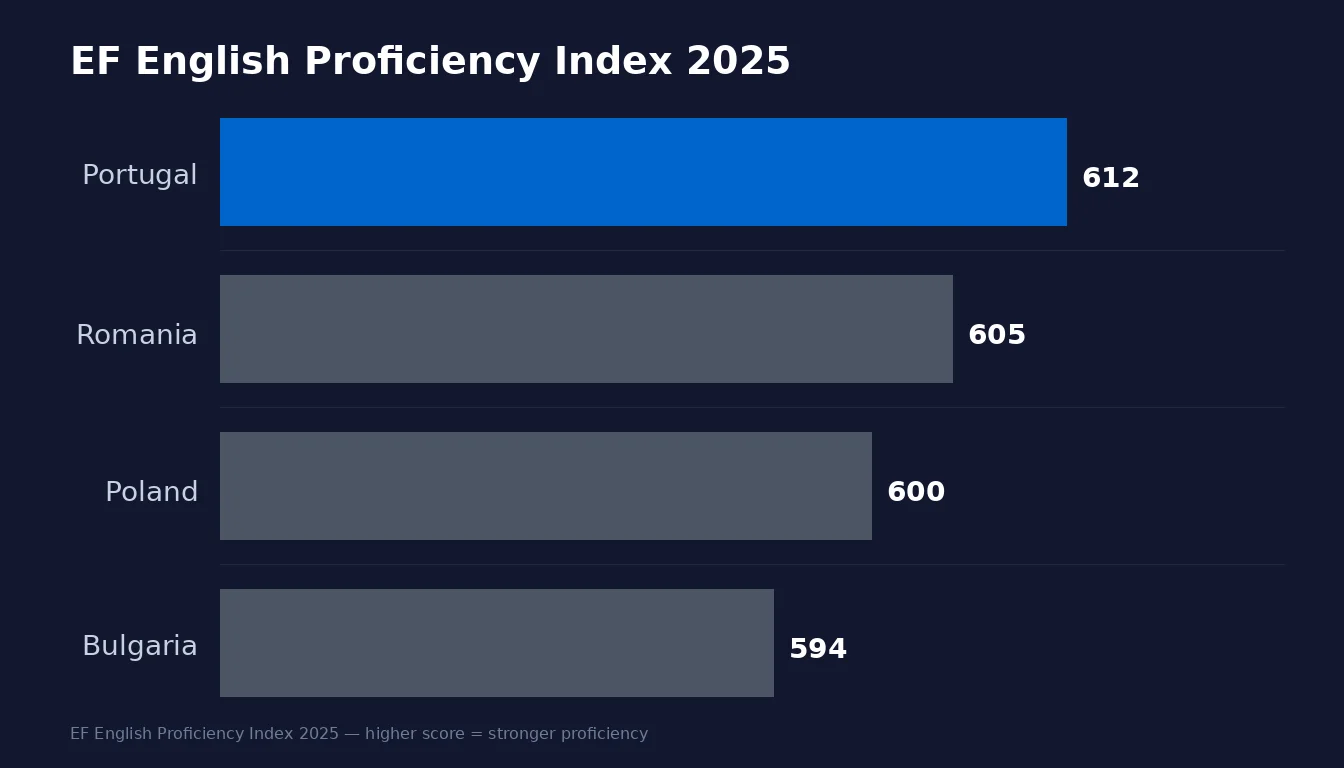
Portugal ranks 6th globally in the 2025 EF English Proficiency Index, with a score of 612 — an all-time high, up from 605 in 2024 — placing it among the top nations for English proficiency worldwide. To contextualise what that means in practice: Romania ranked 11th (605) and Poland 15th (600) in the same index — countries that have been established nearshore destinations for considerably longer. The gap is not trivial. It translates directly into the quality of asynchronous documentation, the accuracy of requirements interpretation, the speed of alignment in distributed standups, and the confidence with which Portuguese engineers engage with client leadership without requiring an intermediary layer.
For companies building systems that involve significant complexity — AI development, systems architecture, integrations with existing enterprise infrastructure — this matters more than it does for simpler implementations. The higher the ambiguity in a technical brief, the more consequential the communication quality of the team executing it. A team that asks the right clarifying questions in fluent English, without hesitation, is a structurally different proposition from one that interprets and proceeds.
Portugal operates on Western European Time (WET/GMT in winter, GMT+1 in summer), which places it in the same timezone as the UK and one hour behind most of Continental Europe. This is a structural advantage that is easy to understate. It means that a company headquartered in London, Amsterdam, Frankfurt, or Stockholm can run a full working day in genuine overlap with a Portuguese team — no early starts, no late calls, no asynchronous gaps that slow down decision-making in fast-moving projects.
The contrast with offshore alternatives is significant: India is typically 4.5 to 5.5 hours ahead of Central Europe, which compresses real-time collaboration into a narrow window at the edges of the working day. Latin American alternatives offer timezone proximity for US-based companies but create exactly that problem for European ones. Portuguese tech professionals already work remotely cross-border primarily for European countries, led by the UK, Germany, and Switzerland, which means the collaboration patterns are established, the workflows are understood, and the infrastructure for distributed European teams is mature.
For digital transformation engagements specifically, timezone alignment affects more than just daily standup scheduling. It affects the speed of architectural decisions, the responsiveness to production incidents, the ability to conduct meaningful discovery sessions with client stakeholders, and the quality of the feedback loop between what is being built and what the business actually needs. A three-hour timezone gap does not sound consequential in a proposal — but compounded over twelve months of active delivery, it consistently adds friction that costs more than the salary differential it was meant to offset.
This factor receives less attention than it deserves in nearshore evaluations, largely because its absence only becomes visible when something goes wrong. Portugal is a stable EU member state, operating under EU legal frameworks for data protection (GDPR), intellectual property, and labour law. Contracts signed with Portuguese partners are enforceable within a well-understood legal system that is aligned with the frameworks most Western European and US companies already operate under.
As geopolitical tensions and economic uncertainties have disrupted traditional nearshore hubs in Eastern Europe, companies from Western Europe and the US have increasingly turned to Portugal as a stable alternative. This is not a fringe concern. Companies that built engineering capacity in Ukraine discovered that geopolitical risk, when it materialises, creates business continuity problems that no contract clause can fully address. The question of where engineering knowledge and system access reside is a risk management question, and for companies building critical infrastructure — operational platforms, data pipelines, AI systems with production dependencies — the stability of the environment where that work is being done is a legitimate variable in the decision.
Portugal's EU membership also simplifies the operational model for European companies significantly. There are no currency risk considerations (Eurozone), no customs complications, no visa friction for onsite collaboration, and no regulatory ambiguity around data handling. For companies working with sensitive data — healthcare, financial services, legal, real estate — these are not minor conveniences. They are the difference between a compliant architecture and a problematic one.
The practical implication is worth stating directly: companies building in Portugal can structure IP ownership, data processing agreements, and employment contracts under a stable, well-understood legal framework from day one — without the legal overhead of cross-jurisdictional complexity that offshore models typically require. For engagements that involve client data, proprietary algorithms, or systems that will eventually be audited, that simplicity compounds over time in ways that are difficult to quantify in a proposal but consistently visible in delivery.
The 90,000 annual engineering graduates figure describes volume. What it does not capture is the ecosystem context that shapes the quality and orientation of those graduates — and that context matters considerably for companies building advanced technical capability rather than simply filling development capacity.
Lisbon and Porto have developed into substantive tech ecosystems over the last decade, attracting international companies and fostering genuine startup density. The annual Web Summit in Lisbon has contributed significantly to Portugal's growing tech prominence, drawing global industry leaders, investors, and talent to the city each year. The effect of that concentration is not purely symbolic — it shapes the professional culture of engineers who grow up in proximity to it. Portuguese engineers in 2025 are not working in isolation from global technical standards. They are working in an ecosystem that is actively connected to how technical problems are being framed and solved internationally.

The government's Tech Visa programme has simplified the hiring of specialists from outside the EU, addressing gaps in emerging technical areas and reducing the friction that typically slows international recruitment. This is particularly relevant for companies seeking AI consulting capacity or specialised machine learning expertise that requires both technical depth and EU legal residency — a combination that is more accessible in Portugal than in most comparable markets.
The majority of Portuguese tech professionals — 48% — actively want to remain in Portugal (Landing.Jobs, Global Tech Talent Trends Report 2025), which is a retention signal that nearshore clients benefit from directly. A team that is not planning to leave is a team that accumulates institutional knowledge, builds client understanding over time, and operates with the stability that complex, multi-year technical engagements require. The alternative — high-churn environments where senior engineers rotate frequently — is one of the primary hidden costs in nearshore models that proposals rarely acknowledge.
The decision to build or extend engineering capacity through a nearshore model is not primarily a cost decision, even when cost is the stated motivation. It is a systems decision — one that determines the quality, speed, and durability of technical execution over a sustained period. The right question is not "where is the cheapest talent?" but "where can we build a team that will actually integrate, perform, and stay?"
Portugal answers that question well because the advantages compound in a way that few nearshore markets currently match. English proficiency reduces daily friction at the level where friction actually accumulates — in code reviews, in requirements discussions, in the moment when an engineer spots a problem and decides whether to raise it or work around it. Timezone alignment means those conversations happen in real time, not in the gap between end-of-day and next morning. EU legal alignment removes the contractual overhead that makes sensitive-data engagements unnecessarily complicated elsewhere. And a talent market that is still scaling — rather than one that has been absorbing international demand for two decades — means the most experienced profiles have not yet been systematically extracted by the companies that arrived first.
What the data describes in aggregate, operational experience confirms at the level of individual engagements. The pattern that stands out is less the individual talent quality — which is consistently strong — and more the speed at which a well-onboarded Portuguese engineer integrates into a client's way of working. The communication threshold is lower, the feedback loops are faster, and the willingness to raise issues proactively rather than wait for a formal check-in is markedly higher than in most other nearshore contexts. These are not cultural generalisations — they are observable patterns that compound over the lifetime of an engagement and directly affect the quality of what gets built.
That said, none of this guarantees a successful engagement. The decision to nearshore solves an access and cost problem. It does not solve a clarity problem, a process problem, or a leadership problem. Companies that go into nearshore arrangements without a clear technical vision, without investment in onboarding and knowledge transfer, and without the internal capacity to direct and evaluate an external team tend to produce the same outcomes regardless of geography. Portugal provides a structurally sound environment. What happens within that environment is still determined by how the engagement is designed and managed.
For companies evaluating staff augmentation or a fully dedicated team model, the structural case for Portugal is strong. The practical case depends on how seriously the engagement design is treated — and that is a conversation worth having before the contract is signed.
Portugal is the stronger choice when the engagement is complex, long-term, or involves systems that require genuine dialogue to build correctly — RAG systems, AI workflows, architectural decisions, integrations with existing infrastructure where the specification is never fully complete at the start. The reason is structural: communication quality is load-bearing in these contexts, and a team operating at EF EPI rank 6 is not marginally different from one at rank 17 or 24 — it is different in kind. Add to this that EU legal alignment simplifies GDPR compliance, IP ownership, data residency, and contract enforceability in ways that matter disproportionately for companies handling sensitive data, and that the 48% retention signal means institutional knowledge actually accumulates rather than rotating out every eighteen months.
Eastern Europe — Poland and Romania in particular — remains a defensible choice when the engagement is well-defined, volume-driven, and does not depend heavily on proactive communication or ambiguity resolution. If the roles are standardised, the stack is established, and the client has the internal capacity to manage a higher-friction collaboration model, the cost advantage holds up. The issue is not that Eastern Europe is poor at execution — it is that the conditions under which it performs well are narrowing as the market saturates and complexity increases.
Offshore alternatives — India and Latin America — make structural sense when the client is US-based and timezone alignment with European markets is not a priority, when the scale of the team required exceeds what Portugal's talent market can absorb at short notice, or when cost is the dominant constraint and quality standards can be enforced through process rather than through communication quality. These are real scenarios, and pretending otherwise would be the kind of oversimplification this article is trying to avoid.
The honest framing is this: Portugal is not the right choice for every nearshore engagement. It is the right choice for companies that have moved past the assumption that nearshore is primarily a cost lever, and are now optimising for the quality and durability of what gets built.
Is Portugal more expensive than Eastern European nearshore destinations?
Portugal's developer salaries are higher than those in Romania or Bulgaria, but lower than Germany, France, or the Netherlands. The relevant comparison is not pure cost but cost-adjusted value: when communication quality, retention rates, timezone alignment, and legal framework are factored in, the total cost of an engagement in Portugal frequently compares favourably with lower-rate alternatives that carry higher operational friction.
How does Portugal compare to India or Latin America for nearshore?
For European companies, the timezone comparison is decisive: Portugal operates in GMT/GMT+1, which means genuine same-day working overlap with the entire European continent. India is 4.5 to 5.5 hours ahead of Central Europe; Latin American countries are 3 to 7 hours behind. Both alternatives require structural adjustments to the working model that Portugal does not.
What types of technical roles are best covered by Portuguese nearshore teams?
Portugal has genuine depth in software engineering across the full stack, data engineering, cloud architecture, AI and machine learning, and cybersecurity. The Lisbon and Porto ecosystems have pulled particularly strongly toward fintech, healthtech, and AI-adjacent development — partly because of the companies that have set up engineering centres there and partly because of the research orientation of the major universities. Where Portugal is less naturally equipped is in highly specialised industrial automation, embedded systems for manufacturing, and legacy enterprise platforms that require decades of institutional exposure. These gaps are not unique to Portugal, but they are real, and companies with requirements in those areas should probe explicitly before assuming coverage.
Does Portugal have enough senior engineering talent, or only junior profiles?
The supply of senior engineering talent is growing but not unlimited — as in any market. The distinction that matters is that Portugal's ecosystem is still relatively early in its nearshore scale-up compared to Poland or Romania, which means senior talent has not yet been systematically absorbed by international demand. Companies that engage seriously and invest in retention tend to secure strong senior profiles; those that treat nearshore as a staffing commodity tend to receive what that approach signals.
What are the main risks of nearshoring to Portugal?
The primary risk is not structural — it is operational. Nearshore engagements that lack clear technical leadership, a well-defined scope, and a serious onboarding process tend to underperform regardless of the location. A secondary consideration is that Portugal's talent market is becoming more competitive, which means salary expectations are rising and companies that offer poor working conditions will find retention more difficult than they did three years ago.
Is Portugal suitable for AI and advanced engineering work, not just standard development?
Yes, and increasingly so. Portuguese universities are producing graduates with strong foundations in mathematics, data science, and machine learning. The ecosystem around Lisbon and Porto has attracted AI-focused companies and research initiatives. For AI automation, RAG systems, and advanced integration work, Portugal has the technical depth to support serious engagements — not just execution-level development.
How quickly can a nearshore team in Portugal be operational?
This depends more on the quality of the onboarding process than on Portugal specifically. Teams that are given clear context, technical documentation, and access to the right people from day one can reach genuine productivity within four to six weeks. Teams that are hired and then expected to figure out the context independently take considerably longer — and that delay compounds, because an engineer who spends the first month interpreting rather than building develops habits of interpretation that persist. The implication for engagement design is straightforward: the onboarding investment is not overhead. It is the variable that determines whether the first three months produce momentum or debt.
If you're building or expanding an engineering team and want to evaluate Portugal as a nearshore base — without the oversimplification of most vendor pitches — speak with our team. We work in Portugal, we hire here, and we can give you an honest assessment of what works, what requires investment, and what to avoid.